
Des Moines and the metro suburbs
Spray Foam Insulation in Des Moines, IA
Closed-cell and open-cell foam where it pays off, blown-in where it costs less, priced in writing after we see the house.
- Free on-site estimates across the metro
- Written quote listing material, depth and R-value for each area
- Air leaks, damp spots and old wiring checked before anything is covered
Insulation Built for Central Iowa Winters
Spray foam insulation in Des Moines has two very different housing stocks to work with. Point2Homes' summary of Census data puts the city's median year built at 1961, with about 26.7% of its homes built before 1940, while suburbs like Ankeny and Waukee have median build years of 2006 and 2011. Winters are cold here too: Wikipedia's Des Moines climate table lists a January average low of 13.8F and about 36.5 inches of snow a season. We air seal and insulate attics, basements, rim joists, walls, garages and shops across the metro, using closed-cell or open-cell spray foam where it makes sense and blown-in insulation where it does the job for less.
What Iowa's code asks for
Polk, Dallas, Warren and Madison counties are all listed in Climate Zone 5A on OpenEI's county map. Iowa's residential energy rule adopts the 2012 IECC with state amendments, and its Table R402.1.1 sets these Zone 5 minimums: R-49 in ceilings; R-20, or R-13 in the cavity plus R-5 continuous, in wood-frame walls; R-30 in floors; R-15 continuous or R-19 cavity on basement walls and crawl space walls. New homes must also pass a blower door test at 4 air changes per hour or less. The same rule says remodeling or renovation of one- and two-family homes is outside the code's scope, so for an existing house those numbers are a target rather than a requirement. We write the target R-value next to each area on the quote either way.
Old city, new suburbs
A 1920s foursquare in one of the older Des Moines neighborhoods and a 2015 two-story in Grimes need different work. Older Des Moines houses often have balloon framing that lets warm air rise from the basement into the attic inside the walls, kneewalls in story-and-a-half homes, and only a few inches of settled insulation overhead. Newer suburban houses are tighter, but we still find bare rim joists all the way around the basement, cold bonus rooms over attached garages, and attic floors with gaps around recessed lights and bath fans. Our quote is built around the house you actually have.
Closed cell vs open cell
Open-cell foam is light and soft, rated about R-3.5 to R-3.7 per inch in HomeGuide's guide. It expands to fill a cavity and stops air well, but it lets water vapor pass, so in a Zone 5 house it needs a vapor plan. Closed-cell foam is rigid and dense, at R-5 to R-7 per inch, and at normal thickness it slows vapor and does not absorb water. In central Iowa that makes closed-cell the usual choice for rim joists, basement walls, roof decks with no vent space and steel buildings. Open-cell fits interior walls, some attic rooflines and sound control between floors. On open attic floors, we usually foam the gaps and blow cellulose or fiberglass on top.
Basements first
Most Des Moines area homes sit on a full basement, and the band of wood on top of the foundation is one of the leakiest spots in the house. The metro also knows water: Wikipedia records that the Des Moines Water Works was flooded on July 11, 1993, leaving 250,000 people without running water for 12 days, and a levee broke in June 2008. If your basement has taken water, we check it is dry and the source is handled before we insulate, and we lean on closed-cell foam because it gives water nothing to soak into.
Choosing among spray foam insulation contractors
When you call spray foam insulation contractors or insulation companies around Des Moines, or search for spray foam insulation near me, ask each one the same questions. What gets sealed before anything is insulated? Which foam goes where, and at what thickness and R-value? How will they handle attic ventilation and cold-weather spraying? How long should the family stay out while it cures (HomeGuide suggests 24 hours or more)? What happens to old, damaged insulation? A good company answers in writing. We do, area by area, so you can line our quote up against any other bid.
Spray foam insulation cost
HomeGuide's 2026 guide lists installed spray foam at $1.50 to $5.00 per square foot: about $1.50 to $3.50 for open-cell and $3.00 to $5.00 for closed-cell. Fixr's figures for an existing home run $3.15 to $7.50 per square foot. HomeGuide puts a rim joist job at about $2,000 to $2,500 and an average attic insulation project at $1,000 to $2,700. These are national ranges. Around Des Moines the age of the house moves the number most: pre-war attics often need cleanup and sealing first, while newer homes are usually quicker. We price your job after we see it, and the written estimate is what you pay.
Rebates
MidAmerican Energy serves much of the metro. Its 2026 Iowa residential rebate terms say qualifying work has to be bought and installed between January 1 and December 31, 2026, applications are due within 90 days of the invoice, and a prescriptive rebate cannot exceed 70% of the equipment cost, with labor excluded. Programs change every year, so check your utility's current list before you book, and keep your invoice. Get a free estimate
Where We Work
We cover Des Moines and Windsor Heights in the middle of the metro, West Des Moines, Clive, Urbandale and Johnston to the west and north, Waukee, Grimes and Adel out in Dallas County, Ankeny, Bondurant, Altoona and Pleasant Hill on the north and east sides, and Norwalk, Carlisle and Indianola to the south in Warren County. Des Moines and Windsor Heights have the most pre-1960 houses with open framing and thin attic insulation. Ankeny, Waukee, Grimes and Bondurant are mostly homes built since 2000, where the work is usually rim joists, bonus rooms and topping up attics. Each town page explains what is different there.
- Spray Foam Insulation in Des Moines, IA
- Spray Foam Insulation in West Des Moines, IA
- Spray Foam Insulation in Ankeny, IA
- Spray Foam Insulation in Urbandale, IA
- Spray Foam Insulation in Johnston, IA
- Spray Foam Insulation in Clive, IA
- Spray Foam Insulation in Waukee, IA
- Spray Foam Insulation in Grimes, IA
- Spray Foam Insulation in Windsor Heights, IA
- Spray Foam Insulation in Altoona, IA
- Spray Foam Insulation in Pleasant Hill, IA
- Spray Foam Insulation in Bondurant, IA
- Spray Foam Insulation in Norwalk, IA
- Spray Foam Insulation in Indianola, IA
- Spray Foam Insulation in Adel, IA
- Spray Foam Insulation in Carlisle, IA
What We Insulate
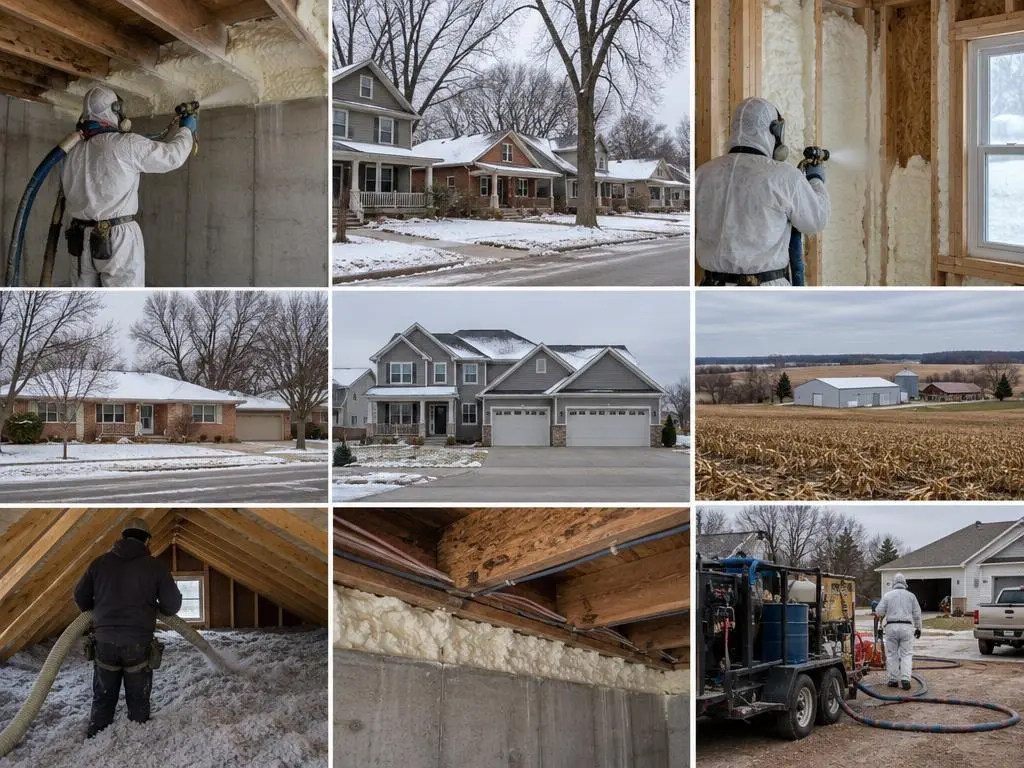
Six kinds of work, each matched to a part of the house or building, from attic floors to steel shop walls.
Spray Foam Insulation
Closed-cell and open-cell foam that insulates and air seals in one layer, for rim joists, walls, rooflines and steel buildings.
Learn more →Attic Air Sealing & Insulation
Sealing the leaks in the attic floor, then bringing it up toward R-49 with blown-in or foam.
Learn more →Basement Wall & Rim Joist Insulation
Closed-cell foam on the rim joist and foundation walls, done before you finish the basement or on its own.
Learn more →Wall Insulation
Spray foam in open walls for additions and new builds, and dense-pack fill for closed walls in older homes.
Learn more →Shop, Garage & Pole Barn Insulation
Spray foam on steel and wood-framed outbuildings to keep them warm and stop condensation drip.
Learn more →Insulation Removal
Taking out wet, matted, contaminated or outdated insulation so the attic or basement can be sealed and redone.
Learn more →Common Questions
What kind of spray foam has the highest R-value?
Closed-cell foam, at about R-5 to R-7 per inch according to HomeGuide, compared with roughly R-3.5 to R-3.7 for open-cell. That is why closed-cell goes in tight spots like rim joists, 2x4 walls and shallow roof bays.
How much would it cost to spray foam a 20x20 garage?
The floor is about 400 square feet, but you insulate the walls and ceiling, which can add up to 1,000 square feet or more of surface. At HomeGuide's $1.50 to $5.00 per square foot, that is roughly $1,500 to $5,000, and small jobs often hit a minimum charge. We measure and give you a written price.
Is there a DIY spray foam kit, and should I use one?
Two-part foam kits are sold for small areas, and canned foam works for sealing small gaps. Larger jobs need the right mix temperature, thickness per pass and ventilation, and mistakes are hard to undo because cured foam must be cut or scraped off. For a rim joist or a whole attic, a professional install is usually the safer choice.
What R-value does a Des Moines attic need?
Iowa's code table lists R-49 for ceilings in Climate Zone 5, which includes Polk, Dallas and Warren counties. Existing homes are not required to meet it, but it is a sensible target, and most older attics we see are well below it.
Can spray foam be installed in winter?
Yes in heated basements and living spaces. Cold attics, garages and pole buildings need the surface and the foam within the maker's temperature range, so we add heat or schedule a milder day.
Should I spray foam my whole attic?
Not always. If the attic is vented and the floor is open, sealing the gaps and blowing loose fill to R-49 usually costs less. Foaming the roof deck makes sense when the attic holds ducts or equipment, or when there is no room to vent a vaulted ceiling.
Why Homeowners Call Des Moines Spray Foam Insulation
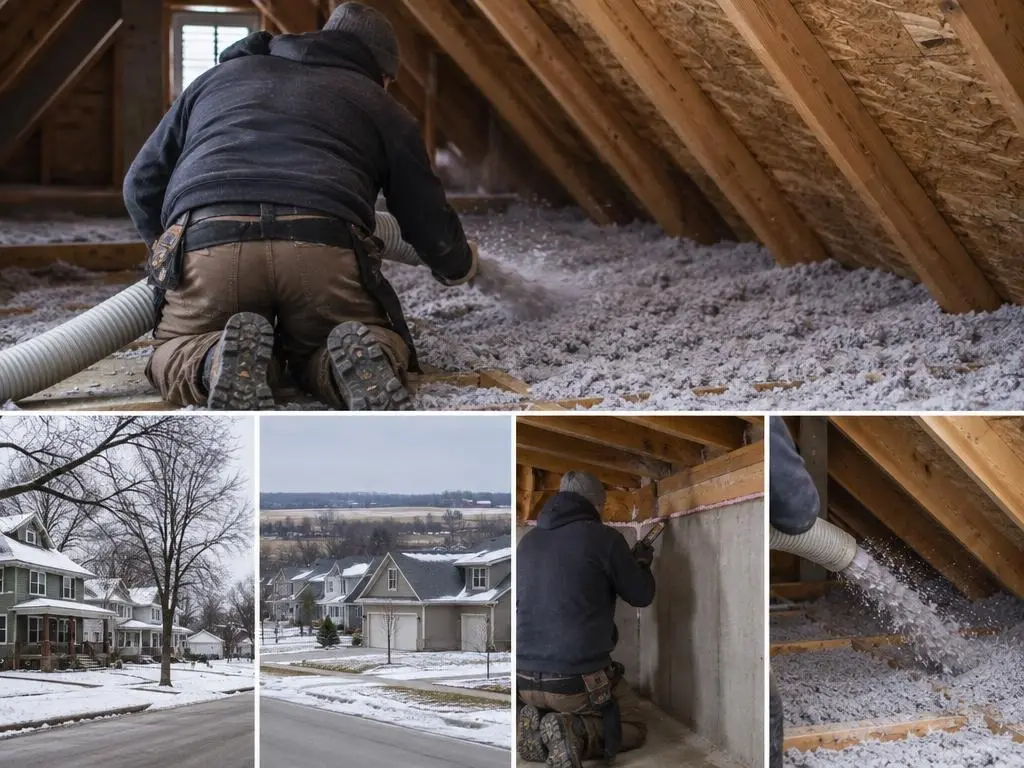
We look before we price
Attic, basement and problem rooms get inspected and measured before a number goes on paper.
Sealing comes first
Top plates, chases, penetrations and the rim joist are sealed before new insulation covers them.
The right material in each spot
Closed-cell, open-cell, cellulose or fiberglass, chosen for the surface and the moisture risk, with the reason on the quote.
Quotes you can compare
Every area lists its material, thickness or depth, target R-value and price.
Get a Spray Foam Insulation Estimate
We check the attic and basement, then send a written price for each area.